
Historic Translation Marks a Milestone for Amazigh Language in Morocco
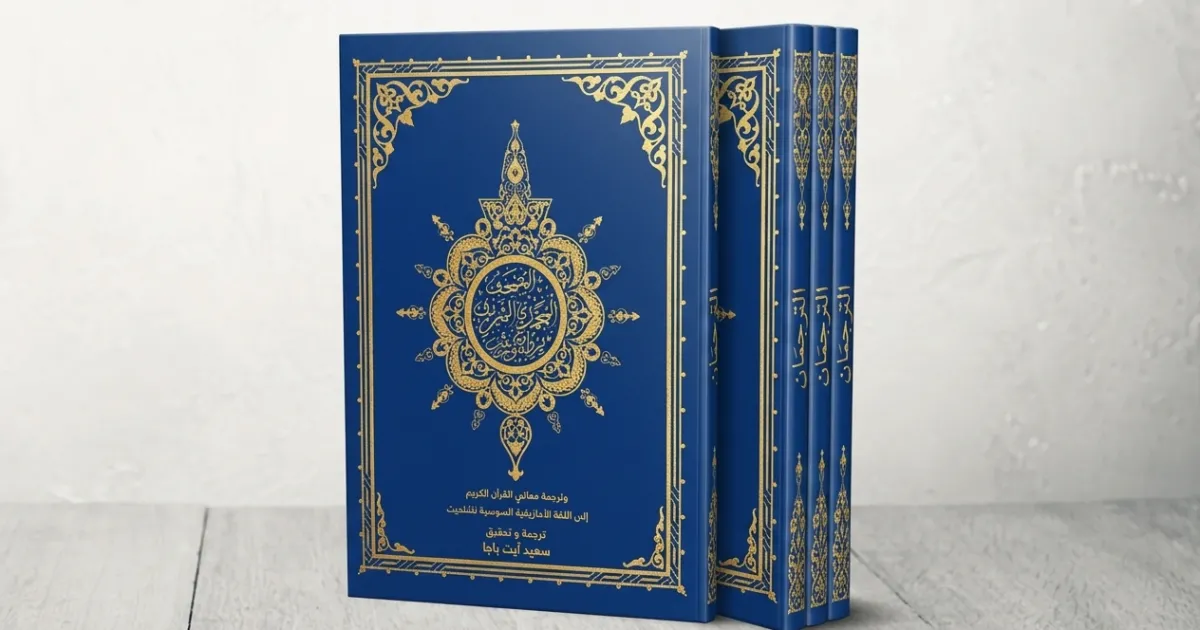
In a groundbreaking development for the Amazigh language, Morocco has released its first official translation of the meanings of the Quran into Amazigh, marking a significant achievement in the promotion of this language, which was established as an official language alongside Arabic under the 2011 constitution. This monumental translation was overseen by the Mohammed VI Foundation for the Publication of the Holy Quran, making it the fourth release in their series of translations, which also includes versions in French, English, and Spanish.
The newly published edition consists of 1,278 pages and is adorned with decorative elements inspired by Amazigh culture, particularly in the division marks and surah separations, which provide a unique visual connection to the Amazigh cultural heritage. The presentation format features the Arabic Quranic text written in Moroccan script on the right side of the pages, while the Amazigh translation is placed on the opposite side, ensuring an accessible and engaging reading experience for audiences familiar with both languages.
The preparation and scholarly review of this translation involved the collaboration of numerous scholars and jurists from traditional schools, mosque imams, and university professors in the Souss region, where the Souss Amazigh language (Tachelhit) is predominantly spoken. The translation was meticulously crafted using the Arabic script, adhering to the grammatical rules of the Souss Amazigh language, drawing on the linguistic principles established by the Moroccan scholar and jurist Mohamed al-Mokhtar al-Soussi.
The scientific committee responsible for this translation placed great emphasis on following established scholarly interpretations from both ancient and contemporary scholars while adhering to Moroccan specificities in Maliki jurisprudence and Ash'ari theology. Furthermore, the reading tradition of Nafi’ and the Warsh narration, as recognized by Al-Azhar University, was adopted in this translation process.
Rich Historical Context and Challenges of Translation
The tradition of translation and authorship in the Souss Amazigh language dates back to the advent of Islam in Morocco in the eighth century. This rich history has produced translations of seminal religious and jurisprudential texts, including a notable translation of the "Mukhtasar of Sheikh Khalil" by the jurist Mohamed bin Ali Al-Houazali in the 12th century, titled "Al-Hawdh," and the translation of Abdullah Al-Tamsaouti's work on Ibn Ashir's verses. Furthermore, Sheikh Ali bin Ahmed Al-Ilghi translated the book "Mujmou' Al-Amir" and titled it "Tafoukt N Al-Din," while the eminent scholar Al-Mokhtar Al-Soussi translated the "Forty Hadiths of Al-Nawawi."
Additionally, there was a significant movement towards creating rhythmic compositions to facilitate memorization and understanding, with jurists composing verses in Amazigh on jurisprudence, biography, and language rules. Of these, the "Bouchaikiri" poem from the late 12th century stands out as a renowned educational piece focusing on the life and praise of the Prophet Muhammad. This literary endeavor extended beyond religious themes to encompass various fields, including agriculture, astronomy, history, storytelling, and linguistics.
As for the translation of the meanings of the Quran, the Soussi community relied primarily on oral interpretations delivered in mosques and Quranic schools. Historical records indicate that Al-Mahdi bin Tumart, the founder of the Almohad state, was the first to translate the meanings of the Quran into writing. However, this translation has since been lost. For centuries, Soussi scholars exhibited caution towards translating the Quran, which was perpetuated by ongoing juristic discussions. An early 12th-century correspondence from scholar Mohamed bin Mohamed bin Abdullah Al-Samlali to Imam Hassan Al-Youssi inquired about the permissibility of translating the Quran into Soussi Amazigh, to which Al-Youssi responded affirmatively, provided that the translator possessed a solid command of both Arabic and Amazigh, emphasizing the importance of good intention and linguistic proficiency.
The modern era saw the first attempt to translate the Quran into Soussi Amazigh in 2003 by Amazigh researcher Hussein Jahadi; however, this effort faced methodological and linguistic criticism and did not achieve widespread acceptance. The idea to translate the meanings of the Quran into Soussi Amazigh (Tachelhit) was revitalized following a seminar organized by local scientific councils in the Souss region in 2012, focusing on "Soussian Efforts in Serving the Quran." This event culminated in a recommendation for a translation project to address the pressing need for such a work in the contemporary era.
According to Mahdi bin Mohamed Saidi, a member of the scientific committee responsible for this translation and a university professor at Ibn Zohr University in Agadir, a specialized scientific committee was formed comprising 16 scholars from traditional schools, mosque imams, and university educators to initiate the project based on the recommendations from the seminar. Saidi attributed the selection of this broad team to the historical juristic principle articulated by Imam Hassan Al-Youssi that emphasizes the necessity of complete proficiency in the Amazigh language.
He noted that the historical barrier faced by Soussi scholars was not a lack of proficiency in Arabic but rather the geographical expanse and the diversity of Soussi dialects stretching from Marrakech in the north to the desert regions in the south, including Asa and Guelmim, and from the Atlantic Ocean in the west to the Sirwa Mountains and Taznakht in the east. The distinctions between dialects and local lexicons among various tribes, such as Idawsmalal, Ait Baamrane, Talioin, and Hahha, necessitated the engagement of scholars representing diverse geographical backgrounds to ensure a translation that encompasses the common linguistic heritage shared by different areas and tribes.
To address the challenges of lexical and stylistic diversity, the scientific committee adopted a rigorous methodological approach that prioritized the most widely used and recognized terms among the Soussi population. In cases where common equivalents were not available, the committee members turned to written literary heritage from ancient Soussi manuscripts and books. When that proved insufficient, they sought insights from elders and experts through field research.
Saidi illustrated the difficulties encountered while translating the word "rheek" from verse 25 of Surah Al-Mutaffifin, "They are given to drink from a sealed nectar." He commented, "We struggled to find an equivalent for the word 'rheek,' as some committee members and others suggested translating it to Soussi Amazigh as 'tilkamas,' which corresponds to 'pollen' in Arabic. We eventually consulted an experienced beekeeper who indicated that the precise term is 'an-nim.'"
The committee members utilized several well-known tafsir (interpretation) texts, including those by Ibn Kathir, Al-Qurtubi, Al-Baydawi, Al-Tabari, and Al-Jalalayn, and also consulted translations of Quranic meanings into other languages, such as French, English, and Spanish, published by the Mohammed VI Foundation for the Publication of the Quran. This was aimed at understanding how these translators dealt with complex meanings in certain verses and leveraging their methodological solutions to ensure the highest levels of accuracy and scientific integrity.
The scientific committee's work on the translation continued until 2014, at which point the project was temporarily halted for six years due to personal circumstances affecting some members. In 2020, efforts were renewed under the supervision and sponsorship of the Mohammed VI Foundation for the Publication of the Quran, which institutionalized the committee's operations. The methodology of the work involved assigning each committee member the task of translating a quarter of each of the four quarters of the Quran into Amazigh, followed by regular weekly meetings to review and discuss the translations collectively.
Saidi emphasized that the translation underwent several rounds of scientific review and continuous collective revisions before it was approved by the committee, with three additional reviews coordinated by the Mohammed VI Foundation for the Quran. The text of the translation was written in Arabic script while adhering to the grammatical rules of Soussi Amazigh. Saidi explained that the use of Arabic script for the translation is a continuation of the documented heritage in the Souss region that spans a millennium, preserving the Soussi heritage of hundreds of texts and manuscripts written in Soussi Amazigh in Arabic script across various sciences.
He affirmed that this translation aims to cater to the general public, addressing those who have a basic understanding of reading and writing in Arabic script, whether they are graduates of the education system or beneficiaries of literacy programs. Following this translation, the committee recommended transforming it into an audio recording project to enable non-literate individuals to listen to it in their native language.
As reported by aljazeera.net.